Religion in Nepal: Hinduism, Buddhism and Spiritual Heritage

Religion in Nepal: Hinduism, Buddhism and Spiritual Heritage
Nov 22, 2026 Nir Saru
From temple bells and Buddhist prayer wheels to ceremonies that honour ancestors and nature, religion is part of everyday life in Nepal. For visitors, understanding these traditions brings deeper meaning to the places they explore and the people they meet

Nepal is a secular country whose constitution protects religious freedom. Its spiritual heritage includes Hinduism, Buddhism, Indigenous traditions and several other faiths. Traditions vary between communities, and many families practise customs drawn from more than one religion. Nepal Travel Guide

Religion in Nepal at a Glance

According to Nepal's 2021 census, the main religious groups are:

Religion

Share of population

Hinduism

81.19%

Buddhism

8.21%

Islam

5.09%

Kirat (Indigenous)

3.17%

Christianity

1.76%

The remaining share includes Prakriti, Bon, Jain, Sikh, Baha'i and other communities. These figures show how people identify themselves in the census. In daily life the lines are often softer: a family may visit a Hindu temple and a Buddhist stupa in the same week. 
Hinduism in Nepal

Hinduism is Nepal's largest religion. You will see its influence in neighbourhood shrines, major temples, family rituals, and annual festivals. Worship takes many forms, including offerings, prayer, pilgrimage, and ceremonies for different deities.

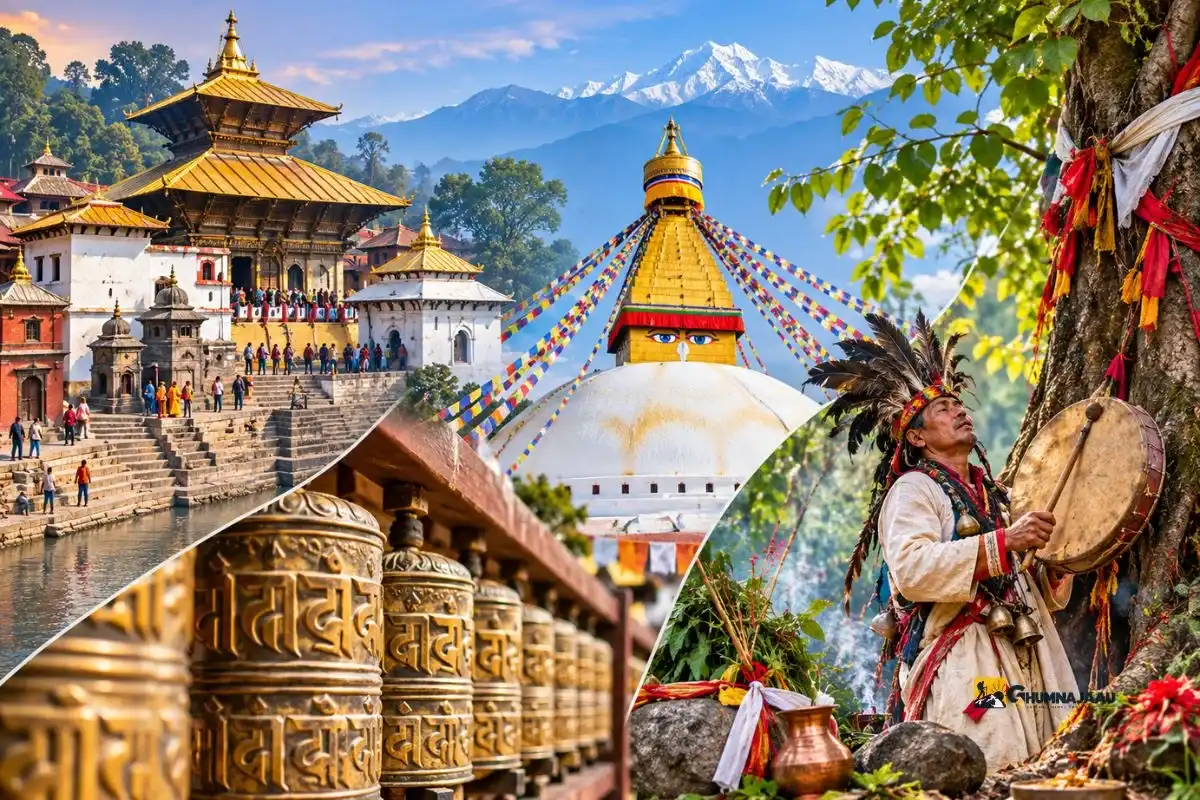
Pashupatinath, on the banks of the Bagmati River in Kathmandu, is one of Nepal's most important Hindu pilgrimage sites. It is dedicated to Shiva, and its wider sacred area includes temples, ritual spaces and riverside cremation ghats. The main temple is open to Hindus only, but visitors can observe the surroundings and evening rituals from the opposite bank.

Other places that show Hindu heritage include Changu Narayan in the Kathmandu Valley, Janakpur in the Terai, and Mustang Muktinath in the Himalaya, which is sacred to both Hindus and Buddhists.

Approach ceremonies quietly. Respect the privacy of worshippers and grieving families, and avoid photographing cremations.

Buddhism in Nepal

Nepal holds a special place in Buddhist history as the birthplace of Siddhartha Gautama, the Buddha. Lumbini, in the southern plains, is a UNESCO World Heritage Site and a major pilgrimage destination. Its sacred garden, Maya Devi Temple and archaeological remains connect visitors with the origins of Buddhism.

In the Kathmandu Valley, Boudhanath and Swayambhunath are the best-known Buddhist landmarks. Their stupas and surrounding streets are places to watch devotion in motion: pilgrims circling clockwise, spinning prayer wheels and lighting butter lamps. Buddhism is also central to life in Himalayan communities, where monasteries remain important centres of religious and community life. Nepal Sightseeing & Cultural Tours

Indigenous Beliefs and Nature Worship

Nepal's Indigenous spiritual traditions are diverse. They include relationships with ancestors, sacred landscapes and spiritual beings, alongside ceremonies connected to community life.

Kirat traditions, associated especially with communities such as the Rai and Limbu, are an important part of this heritage. Ancestors and nature feature prominently, although beliefs and ceremonies differ between communities. Nepal's census also records identities such as Prakriti and Bon.

"Nature worship" is a broad description, not one shared religion. It should not be used to suggest that all Indigenous people follow the same beliefs. When you explore these traditions, let community members explain their own practices and ask which experiences are appropriate for visitors.

Shared Sacred Places and Living Heritage

Nepal's religious traditions have influenced one another over centuries. In the Kathmandu Valley, Hindu and Buddhist heritage meet in architecture, sculpture and sacred spaces, and UNESCO recognises this as an important feature of the valley's cultural heritage. Read more in our Kathmandu Valley guide.

This heritage continues through worship, craftsmanship, storytelling and community ceremonies. A temple courtyard or monastery is more than a historic attraction. It may also be a place where people gather, pray and keep traditions alive. Many of these traditions come alive during Nepal's festivals, which you can explore in our guide to the major festivals of Nepal.

Nepal is also home to Muslim, Christian, Jain, Sikh, Baha'i and other communities. Knowing this wider diversity gives visitors a fuller picture of the country.

Visiting Sacred Places Respectfully

A thoughtful approach protects both religious spaces and the dignity of the people who use them.

  • Wear modest clothing, with shoulders and knees covered.
  • Remove shoes where required.
  • Check entry rules before entering temples.
  • Walk clockwise around Buddhist stupas.
  • Ask before photographing people or ceremonies.
  • Follow the guidance of caretakers, hosts and local guides.
  • Do not try to convert or preach to others. Nepali law restricts efforts to change someone's religion.

Some Hindu temples restrict entry to Hindus, and photography rules differ between sites. Always check locally before you enter or take pictures. For more everyday customs, read our guide to Nepal culture and etiquette.

Explore Nepal's Spiritual Heritage

Discover sacred places, learn from local perspectives and make time for the traditions that give each destination meaning. Ghumnajaau's local guides can explain what you see and help you visit with respect.

Share your travel dates, group size and interests, and we will help plan a cultural or spiritual journey through Nepal. Customize My Trip

Religion in Nepal FAQs

Hinduism is the largest religion, followed by about 81% of people in the 2021 census. Buddhism, Islam, Kirat and Christianity are also significant, and Nepal has many smaller faith communities.

Nepal is a secular country. Hinduism is the majority religion and strongly shapes culture and festivals, but the constitution protects religious freedom for everyone.

Lumbini is recognised as the birthplace of the Buddha and is one of the most important destinations for Buddhist pilgrimage.

No. Indigenous communities have diverse religious identities and practices. Beliefs also vary between families and individuals.

Non-Hindus cannot enter the main temple, but they can explore the surrounding area and watch rituals from the opposite bank of the Bagmati River.

Some ceremonies welcome respectful observers, while others are private or restricted. Ask your guide, host or the people in charge before you join or photograph an event.

Plan Your Trip with Ghumnajaau

This data will only be used by our team to contact you and no other purpose.